

Driving Progress Towards SDG 9 and SDG 11 through Cybersecurity and Innovation
The Sustainable Development Goals (SDGs) are 17 interconnected goals established by the United Nations in 2015 to tackle pressing global challenges such as poverty, hunger, education, gender equality, sustainable energy, and climate change, with the aim of creating a better world by 2030. The COREnext project plays a pivotal role in advancing two of these goals: SDG 9: Industry, Innovation, and Infrastructure, and SDG 11: Sustainable Cities and Communities. By integrating cutting-edge digital components and architectural innovations, the project ensures that infrastructure and urban development remain both resilient and energy efficient.

Building Trustworthy and Resilient Digital Infrastructure (SDG 9)
SDG 9 aims to foster resilient infrastructure, promote sustainable industrialisation, and support innovation. As part of Work Package 4 (Digital Components: Components for power-efficient signal processing, and Components for isolation, orchestration & TEEs) in the COREnext project, the focus is on developing trustworthy infrastructure that ensures resilient industrial and societal digitisation. These digital components play a pivotal role in ensuring the security of industries and communities during digital transformation. COREnext enhances system security by implementing robust component isolation and minimizing trusted computing bases, thereby reducing the attack surface and improving overall resilience.
Additionally, Work Package 3 (Trustworthy Disaggregated Computing Architecture) contributes to SDG 9 by shaping an architecture that promotes secure and scalable digital infrastructure, which is vital for sustainable development in various sectors, from transport to energy. To fully achieve SDG 9 by 2030, investments in infrastructure - including transport, irrigation, energy, and information and communication technology - are crucial. Supporting Least Developed Countries (LDCs) through investments in advanced technologies, reducing carbon emissions, and expanding mobile broadband access are essential steps toward empowering communities and fostering sustainable development.
Enhancing Energy Efficiency for Sustainable Cities (SDG 11)
SDG 11 aims to make cities inclusive, safe, resilient, and sustainable. COREnext supports this by improving energy efficiency through accelerator integration, enabling hardware to perform tasks previously handled by software on general-purpose processors. The digital innovations within Work Package 4 enable the integration of energy-efficient solutions into digital infrastructure by systematically replacing inefficient components with more efficient alternatives. This facilitates the operation of smart cities with reduced energy consumption and lower carbon footprints, thereby promoting sustainability by optimizing energy consumption and management in urban environments.
Digitalisation also plays a vital role in boosting energy efficiency across various sectors, contributing directly to SDG 11's sustainability targets. By incorporating innovative technologies, cities can reduce their environmental impact, improve public services, and ensure long-term resilience to climate change and population growth.
What Needs to Be Done to Achieve SDG 9 and SDG 11 by 2030
While the COREnext project is making contributions, there is still work to be done to fully achieve these goals by 2030. For SDG 9, it is essential to:
- Continue investing in infrastructure in critical areas like transport, energy, and communication technology.
- Increase support for LDCs by investing in advanced technologies and ensuring their inclusion in global digital advancements.
- Focus on lowering carbon emissions through sustainable industrial practices.
- Improve access to mobile broadband, ensuring that all regions, particularly underserved ones, can benefit from digital innovations.
- For SDG 11, more efforts should be made to:
- Boost energy efficiency through further digitisation and integration of smart technologies in urban areas.
- Promote the use of sustainable energy solutions in cities to minimise their carbon footprint and improve the overall quality of urban life.
A Secure and Sustainable Path Forward
COREnext's contributions to SDG 9 and SDG 11 showcase how cybersecurity and digital innovation can directly impact global sustainability efforts. By prioritising trustworthy infrastructure, improving energy efficiency, and promoting inclusive digitisation, COREnext is helping to shape a future where industries and cities are not only more secure but also more sustainable. Achieving these goals by 2030 will require continued innovation, investment, and global collaboration.
Stay tuned for further updates as COREnext continues to drive forward the future of sustainable and secure infrastructure.
Subscribe to our Newsletter, and follow us on X, LinkedIn, and YouTube!


Advancements in COREnext WP3 Architecture - Building Trustworthy and Efficient Systems for the Future
The COREnext project continues to make significant strides in developing advanced architecture for trustworthy and efficient digital infrastructures. The focus of Work Package 3 (WP3) is to ensure that the project’s architectural design not only meets the current technological needs but also anticipates future challenges. This post highlights the latest developments and achievements within WP3.
Objectives of WP3
WP3 is dedicated to translating the requirements outlined in Work Package 2 (WP2) into tangible architectural strategies. The first phase involved breaking down these requirements into architecture concerns, with a focus on defining disaggregation dimensions, data flows, and attacker models. The architectural design spans three key tiers: terminal, base station, and edge cloud, each with specific security and data flow requirements. The data flows between these tiers must be carefully managed to ensure efficiency and security, from the internal cores within systems-on-chip to services across radio links.
In the next phase, WP3 focused on identifying the necessary component innovations to advance both processing capabilities and system trustworthiness. This involved pinpointing the key technology building blocks that are essential for progressing the overall architecture. The team worked closely with WP4 and WP5 to translate these architectural needs into specific component advancements.
Balancing trustworthiness and efficiency is a core challenge in the architecture, and WP3 has been continuously analyzing the trade-offs. This work ensures that components developed in WP4 and WP5 meet the validation targets set by WP6.
Key Architectural Elements
The COREnext architecture comprises multiple tiers—terminal, base station, and edge cloud—each playing a critical role in managing data and ensuring secure communication. Data flows occur within system-on-chip cores, between servers on physical sites, and across radio links connecting these systems. Managing these flows effectively is essential for maintaining both efficiency and security.
Technology Building Blocks and Innovations
Significant progress has been made in identifying key technology building blocks that support the advancement of the COREnext architecture. Joint Communication and Sensing was identified as an essential capability, where communication antennas can be used for radar sensing. However, this approach raises privacy concerns that need to be addressed. In terms of performance, heterogeneous accelerators were identified to enhance both performance and energy efficiency.
Another critical innovation involves virtualization and disaggregation, which helps increase resource utilization by allowing more flexible allocation of computational power. For security, component isolation and access control were identified as key elements, implemented through capability-based systems that uphold the principle of least authority (POLA). In addition, WP3 developed systems for trusted execution and attestation, providing cryptographic proof of software operations on remote machines, which ensures secure execution across the network.
Challenges and Solutions in Integration
WP3 faced several challenges related to integrating a diverse set of components, often from third-party vendors. The project aims to balance trustworthiness and efficiency while incorporating both trusted and untrusted elements. To address these challenges, WP3 introduced the M³ hardware/software co-design platform, which helps reduce the system's attack surface. Additionally, a Trusted Communication Unit was developed to ensure secure isolation and communication between components.
Impact and Contributions
The advancements within WP3 have led to multiple impactful outcomes. So far, six publications have emerged from the work, contributing valuable knowledge to the community. The M³ platform is now available as open-source hardware and software, fostering further innovation and collaboration in the field.
WP3’s contributions have also extended into standardization and regulation. Enhancements to 3GPP RAN have been proposed, particularly for supporting low-end devices. Regulatory opportunities related to Joint Communication and Sensing were also identified, creating pathways for further integration of these technologies.
In addition to these technical advancements, WP3 plays a pivotal role in achieving the project’s sustainability goals. By aligning with Sustainable Development Goal (SDG) 9, the architecture promotes trustworthy infrastructure, essential for resilient industrial and societal digitization. WP3 also contributes to SDG 11 by integrating energy-efficient accelerators that support sustainable smart cities.
Product and Business Opportunities
WP3’s innovations offer significant benefits for European companies by focusing on trustworthiness and efficiency in their designs. The architecture is compatible with existing software stacks, which ensures seamless integration with traditional hardware components. Furthermore, by connecting the edge cloud with terminal systems, WP3 opens up new avenues for product development and business opportunities.
With the M³ platform available as open-source hardware and software, the project promotes open innovation, creating opportunities for other organizations to build upon its advancements. As COREnext progresses, the contributions of WP3 will continue to be central to its success, ensuring that both trustworthiness and efficiency remain at the forefront of its architecture.
Want to know more stories from COREnext? Subscribe to our newsletter and follow us on LinkedIn, X, and YouTube to keep up to date!

Frida Strombeck Presents Latest Research at European Microwave Week 2024
At the prestigious 27th European Microwave Week (EuMW 2024) in Paris, Frida Strombeck showcased the research on high-speed polymer microwave fiber communication technology. As part of the COREnext project, Frida's presentation focused on the findings outlined in her scientific paper titled "A Transmitter/Receiver Link for High Data Rate Polymer Microwave Fiber Communication at Y-band".

This paper presents the design and fabrication of a Y-band (170-260 GHz) ultra-high data rate transmitter (Tx) and receiver (Rx) using a 130 nm SiGe BiCMOS process. The system successfully demonstrates data rates up to 30 Gbps over a one-meter polymer microwave fiber (PMF) link, operating at a carrier frequency of 237 GHz. This achievement marks the first PMF link above 200 GHz to reach a one-meter distance, highlighting the potential of PMF technology as a robust and cost-efficient solution for high-frequency, high-data-rate communication systems, particularly in applications like intra-box or module-to-module vehicle communications.
The 27th edition of the European Microwave Week (EuMW 2024) took place in Paris, continuing the long-running series of successful microwave events that began in 1998. EuMW 2024 featured three co-located conferences: the European Microwave Conference (EuMC), the European Microwave Integrated Circuits Conference (EuMIC), and the European Radar Conference (EuRAD). In addition to these, the event hosted forums on Defence, Security and Space, the Automotive Forum, the 6G Forum, and a large trade show. Attendees had the opportunity to engage in conferences, workshops, short courses, and special events like Women in Microwave Engineering. The event also included Europe's largest RF and microwave trade show, complemented by technical seminars and exhibitor workshops showcasing commercial products and innovations.
Presentations at such high-profile conferences highlight the importance of innovative microwave technology in achieving faster and more reliable communication systems. The COREnext project, through research of this kind, continues to drive advancements in digital communication and infrastructure.
Stay tuned as the publication: "A Transmitter/Receiver Link for High Data Rate Polymer Microwave Fiber Communication at Y-band" will available soon on IEEE platform and our website!
Want to know more stories from COREnext? Subscribe to our newsletter and follow us on LinkedIn, X, and YouTube to keep up to date!

Advancing Real-Time Capabilities in Cyber-Physical Systems: Core-Local Reasoning with M³

RTAS'24 invites papers that describe case studies, applications, methodologies, and algorithms contributing to the state of practice in the design, implementation, verification, validation, and evolution of time-sensitive systems. That’s where Nils Asmussen, Sebastian Haas, Adam Lackorzyński, and Michael Roitzsch presented their paper, "Core-Local Reasoning and Predictable Cross-Core Communication with M³."
Their research addresses the need for security, heterogeneity, and real-time operation in modern cyber-physical systems. While traditional real-time operating systems like FreeRTOS offer high predictability, they lack the strong component isolation necessary for platform security. Conversely, microkernels provide this isolation but complicate real-time analysis due to their use of virtual memory and privileged CPU modes.
The team introduces an alternative approach with M³, a hardware/software co-design for heterogeneous systems that ensures strong isolation between cores. The real-time capabilities of M³ had not been explored until now. To address this, researchers assessed M³’s current real-time capabilities, comparing its communication latencies with other systems and examining its unique core isolation approach.
To enhance M³'s suitability for real-time applications, they introduced network-on-chip traffic regulation and enforced resource limits. These improvements allow for local reasoning about application execution, making M³ more effective for real-time tasks.
Their evaluation, conducted using an FPGA-based hardware prototype and simulations based on gem5, demonstrates the potential of M³ to meet the demands of secure and predictable real-time systems.
The full paper is available here.
See other COREnext scientific publications here.
Check the COREnext white paper here.

Exploring New Horizons in Datacenters: Disaggregation-Native Data Streaming
At the 2024 ACM International Conference on Architectural Support for Programming Languages and Operating Systems (ASPLOS), Nils Asmussen and Michael Roitzsch presented their paper, "Towards Disaggregation-Native Data Streaming between Devices," during the 3rd Workshop on Heterogeneous Composable and Disaggregated Systems (HCDS).

Their research explores the emerging trend of disaggregation in datacenters, a method aimed at enhancing flexibility. Disaggregation involves using technologies like CXL to connect pools of CPUs, accelerators, and memory through a datacenter fabric. This setup allows applications to select the specific resources they need from these pools, optimizing performance and efficiency.
However, a challenge arises with data movement. Typically, data needs to be streamed through multiple devices, but instead of flowing directly from one device to another, it often gets staged in memory by a CPU. This staging can create delays and inefficiencies.
The researchers propose a solution: a disaggregation-native and device-independent data streaming facility. This innovation enables data to flow directly between devices without the need for intermediary staging in memory. The result is improved processing speeds and reduced latencies, making datacenters more efficient.
Their full paper can be accessed here.
Check out all list of COREnext scientific publications here.

Trustworthiness in the Digital Era: Invitation to EuCNC Convened Session 4 on 5th June
Join us for an insightful session regarding the future of trustworthiness in the digital realm at Convened Session 4 on 5th June at EuCNC conference. This session, chaired by Patrick Pype and Manuela Neyer, will discuss the critical domains of security, reliability, and beyond.
The session will commence with an overview of the current threat landscape, as outlined in the forthcoming ICS CERT landscape report by Kaspersky. These findings will underscore the urgent need for robust solutions to counter malicious attacks, and ensure the integrity of our digital systems.
A central focus of the session will be the role of trustworthiness throughout the lifecycle of microelectronics. As microelectronics increasingly permeate every aspect of modern life, ensuring their reliability and security will be paramount. From design to manufacturing to operation, each phase must undergo meticulous scrutiny to mitigate risks and threats effectively.

Attendees can anticipate an in-depth presentation of the recently published COREnext White Paper, which offers valuable insights into future strategies for enhancing trustworthiness in microelectronics. Fredrik Tillman from Ericsson and Zulaicha Parastuty from Infineon will provide a preview of the proposed solutions, emphasizing the importance of preventive measures and rigorous verification processes.
The session will culminate in a dynamic panel discussion featuring industry luminaries such as Patrick Pype, Franz Dielacher, Stefan Wunderer, Panagiotis Demestichas, and Mamoun Guenach. Participants will discuss the challenges posed by cybersecurity threats and explore potential solutions to address them. Collaboration and knowledge-sharing among stakeholders will be key themes of the discussion, driving advancements in trustworthiness across industries.
Check the details of the session HERE

COREnext Releases White Paper: Trustworthiness – The Key to Europe’s Digital Future
COREnext, a EU-funded project focused on advancing Europe's digital infrastructure, released its latest white paper, "Trustworthiness – The Key to Europe’s Digital Future." This comprehensive study examines the critical role of trust and security in the digitalisation process, underscoring the essential steps needed to maintain Europe's leadership in high-end consumer goods.
The COREnext white paper will be presented during Convened Session 4 at the EUCNC | 6G Summit in Antwerp, Belgium, on Wednesday, 5 June 2024, at 16:00 by Fredrik Tillman from Ericsson and Zulaicha Parastuty from Infineon. The whole session will be devoted to the importance of trustworthiness in the digitalisation process.
Read the White Paper
The paper opens with a discussion, based on Abraham Maslow’s theory, on the significance of trustworthiness for both humans and machines in a fully connected world. It acknowledges digitalization as both a challenge and an opportunity for Europe, stressing the necessity to focus on areas and technologies that enable a secure digital future.
Key recommendations outlined in the white paper include:
- Ensuring the reliability and security of processing units.
- Exploring scalable and flexible digital infrastructures.
- Advancing sensing technologies and physical layer innovations.
- Developing secure and reliable Radio Access Networks (RAN).
A call to action is extended to stakeholders to embrace these priorities, emphasising the importance of trust and security. This will ensure a continued high European value content in products as these become a natural and integrated part of consumers' digital ecosystems.
To download the white paper click here.
COREnext is an initiative funded by the European Union’s Horizon Europe Research and Innovation programme under grant agreement N° 101092598.
KEY CONTACTS
Coordinator: Michael Roitzsch (Barkhausen Institut) - michael.roitzsch@barkhauseninstitut.org
Communication: Arantxa Echarte (AUSTRALO) – arantxa@australo.org
FOLLOW US!
 |
@COREnext_EU |  |
/corenext-eu |  |
corenext.eu |

European Core Technologies for Next Generation Communication-Computing Hardware
COREnext Press Release
In an era where digital transformation is paramount, Europe stands at the forefront of innovation, poised to strengthen its digital capabilities and lead the charge towards a more connected and technologically advanced future. At the heart of this endeavour lies COREnext, a pioneering collaborative initiative that marks its first-year anniversary with a resolute commitment to anticipating the technological developments required for future 6G networks.
6G use cases offer great benefits to the European economy and society, and the intended 6G applications will permeate people’s personal life and will be deployed in critical infrastructure. For that reason, European capabilities in that field will be of high importance to ensure high levels of data privacy, security and contribute to EU’s digital sovereignty. COREnext brings together major European representatives from the telecommunication and semiconductor industries to meet these goals.
COREnext will develop a trustworthy-by-design platform and thus answer the need for European capabilities for B5G/6G computing based on a new architecture for base stations. This architecture will efficiently and securely integrate third-party accelerators capable of supporting even the most demanding 5G/6G processes in cloud servers, base stations, and client-side devices. COREnext will strengthen its European position beyond B5G/6G RAN disaggregated architectures by adding trustworthy-by-design digital and analogue components.
The project brings together major telecommunications and microelectronics players and academic research partners across 10 EU countries to realise these goals by December 2025. COREnext adopts a strong interdisciplinary approach: having different academic disciplines working together with industry collaborators to integrate knowledge and methods to develop and meet shared goals, achieving a real synthesis of approaches. A strategic roadmap will offer a transparent path towards the future exploitation of the generated research results, fostering a continuing European strategy for emerging European digital capabilities in this communication-computing domain.
COREnext is a joint initiative by Barkhausen Institut, Australo, Chalmers University, CEA, Ericsson, Cyberus Technology, EURECOM, Infineon Technologies, imec, NXP Semiconductors, Radiall, Sequans Communications, Technische Universität Dresden, TIM, WINGS ICT Solutions, IMS Research Center, ETH Zurich, IHP, Nokia Germany, Nokia Network France, III-V Lab, Infineon Technologies, and KALRAY.
COREnext is an initiative funded by the European Union’s Horizon Europe Research and Innovation programme under grant agreement N° 101092598.
KEY CONTACTS
Coordinator: Michael Roitzsch (Barkhausen-Institut) - michael.roitzsch@barkhauseninstitut.org
Communication: Arantxa Echarte (AUSTRALO) – arantxa@australo.org
FOLLOW US!
| |
@COREnext_EU | |
/corenext-eu | |
corenext.eu |
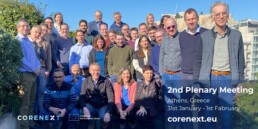
COREnext 2nd Plenary Meeting in Athens: project highlights
In the heart of ancient Athens, where history and modernity coalesce, the COREnext team recently convened for the 2nd Plenary Meeting, setting the stage for an enriching two days of collaboration, innovation, and strategic planning. This gathering not only marked a moment of reflection on past achievements but also laid the groundwork for the future trajectory of the COREnext project.

The meeting commenced with a holistic status check, providing an insightful overview of the current state of the COREnext project. Milestones achieved were celebrated, providing a comprehensive understanding of the journey thus far. This introspective analysis served as a catalyst for envisioning future breakthroughs. As the Project Coordinator, Michael Roitzsch from the Barkhausen Institute claimed:
The COREnext project has met in Athens to plan its second year. Hosted by WINGS, we were greeted by nice weather and the Athens Parthenon looking over our meeting location. After having defined an architecture for trustworthy 6G networks in 2023, this year COREnext will build key components to realize this architecture. We brainstormed about research efforts, publications, and demonstrators. A lot of exciting work lies ahead of us!
Platform Architecture Recap
The very essence of COREnext was revisited with a detailed Platform Architecture Recap. Team members delved into the foundational elements, reinforcing the importance of a robust architecture that fosters seamless collaboration and operational efficiency. This session reinforced the commitment to building a technological infrastructure that stands the test of innovation.
The corenext consortium will develop a trustworthy-by-design platform based on a new computing architecture for base stations to push european capabilities in b5g/6g to the next level.
Advancing Use Cases
The meeting showcased tangible progress as the team explored advancements in COREnext's use cases. From ideation to implementation, the project is transforming innovative ideas into tangible solutions that will impact 6G real-world scenarios. This commitment to practical applications reinforces COREnext's role as a driving force in technological advancements.
COREnext, through the use cases, will help define trustworthiness and processing efficiency based on the paramount importance of reliability, availability, security, privacy and integrity for a society based on European values of privacy and data protection.
Strategic Mapping
Eyes set on the future, strategic discussions unfolded as the team mapped out the trajectory for COREnext's ascent to new heights of innovation. These forward-thinking dialogues ensure that the project remains at the forefront of technological advancement, continually pushing boundaries and exploring new frontiers in XR, manufacturing, and automotive.
Global Resonance Through Outreach
COREnext is not merely a local endeavor—it's a global vision. The team unveiled plans for comprehensive outreach activities, ensuring that the project's vision resonates across the tech landscape in Europe. The upcoming white paper, 'Trustworthiness: The Key to Europe's Digital Future,' promises to usher in a new era of insights for the industry, providing a strategic roadmap for cultivating trust in Europe's digital landscape. This strategic approach aims to amplify the European presence of COREnext, fostering collaboration and knowledge exchange on a wider scale.

COREnext Cyber Security Campaign 2023: Unveiling the Growing Threats Across Industries
In an era dominated by technology, the manufacturing industry finds itself at the forefront of an escalating wave of cyber threats. Recent research sheds light on the most pressing concerns facing the sector in the first half of 2023. Here's an overview of some key findings and a few recommendations to navigate the complex cyber landscape.

Manufacturing: A Prime Target
The manufacturing industry is a lucrative target for cybercriminals, hacktivists, and nation-state-aligned attackers. Cybercriminals and hacktivists are drawn to manufacturing due to its low tolerance for outages – disrupting IT services often halts production, resulting in missed revenue. Additionally, state-aligned groups target manufacturing organizations for their links to critical national infrastructure and potential intellectual property treasures.
Nation-state-aligned groups pose a significant threat, exemplified by the China-based advanced persistent threat group Volt Typhoon targeting U.S. critical national infrastructure, specifically manufacturing, in May 2023. Hacktivist group Killnet, aligned with Russia, remains a prominent risk, targeting the aerospace subsector and posing a continued threat in the second half of 2023.
European manufacturing sector accounted 14% of the global incidents, and it’s the 2nd place in the world in 2023. The 1st position belongs to Asia-Pacific region where 61% cases were reported.
Ransomware Reigns Supreme
Ransomware emerges as another significant threat to the manufacturing sector. Cyber attacks surged across all manufacturing sub-groups from the second half of 2022 to the first half of 2023:
- Industrial goods and services organizations faced a 24% increase.
- Aerospace organizations witnessed a staggering 195% surge.
- Chemicals organizations experienced a 92% rise.
- Automobiles and parts organizations encountered a 53% increase.
The Clop ransomware cybercriminals continued its data-theft campaign into the second half of 2023, emphasizing the persistence of this threat. Manufacturing organizations are urged to prioritize measures against ransomware, including regular system patching, data backup, secure storage practices, and proactive threat hunting.
Ransomware dominated the European cybersecurity landscape, constituting 26% of all attacks on the continent. Following closely were server access attacks at 12% and data theft at 10%, ranking as the subsequent prevalent attack types.
Operational Technology Security at Risk
The convergence of operational technology (OT) with traditional IT systems introduces new vulnerabilities. While integrating OT with IT systems enhances performance, it also escalates cyber risk. Attackers target OT systems by exploiting vulnerabilities commonplace across sectors, including unpatched vulnerabilities, weak credentials, and exposed remote services.
The Oldsmar water treatment plant (Florida, USA) incident in 2021 exemplifies the potential consequences. Attackers compromised the network through a dormant TeamViewer remote access account, highlighting the ease with which common IT weaknesses can be exploited to interfere with critical OT systems.
The overarching trend in Europe over the past decade has been the surge in cybercrime, marked by increased tool availability, easier exploit acquisition, and heightened motivation among cybercriminals. Ransomware and extortion campaigns, in particular, have emerged as prominent tools causing significant harm to organizations. Within Operational Technology, there has been an alarming 87% surge in ransomware attacks against industrial organizations, accompanied by a 35% increase in the number of threat groups in 2021.
Strengthening IT/OT Resilience
To enhance resilience against evolving threats, manufacturing organizations are advised to:
- Conduct regular security assessments of OT systems.
- Implement continuous vulnerability assessment and triage.
- Ensure timely updates for key components of the OT network.
- Deploy endpoint detection and response (EDR) solutions for timely threat detection.
- Enhance incident prevention, detection, and response skills through dedicated OT security training.
The interconnected nature of global infrastructure necessitates a proactive, collaborative approach to cybersecurity. By understanding and addressing the evolving threat landscape, manufacturing organizations can fortify their defenses, safeguard critical assets, and contribute to a more secure digital ecosystem.
Source:
https://www.picussecurity.com/resource/blog/regions-and-industries-at-risk-august-2023
https://www.reliaquest.com/blog/cyber-threats-to-manufacturing-industry-1h-2023/
6 Industries Most Vulnerable to Cyber Attack in 2023 (potomac.edu)
The Latest Cyber Crime Statistics (updated October 2023) | AAG IT Support (aag-it.com)