
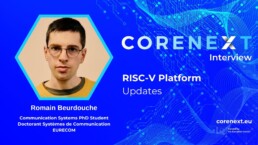
Advancing Open Air Interface 5G with RISC-V and Hardware Acceleration, an Interview with Romain Beurdouche from EURECOM
Romain Beurdouche, a doctoral researcher in Communication Systems at EURECOM, recently discussed key updates on integrating hardware accelerators with the Open Air Interface (OAI) 5G RAN stack, with a particular focus on the role of RISC-V platforms. In this interview, he outlines both the technical strides made so far and the expected outcomes from ongoing research.
Romain reflects on the early stages of hardware integration in the OAI project, which began with a forward error correction (FEC) accelerator embedded within an FPGA card specifically built for 5G operations. Although this initial attempt marked a significant milestone, the integration was suboptimal. Key inefficiencies stemmed from underutilised APIs and an inability to effectively share the accelerator across different workloads.
The COREnext initiative provided a critical opportunity to address these issues. As Romain Beurdouche explains, the project focused on refining the efficiency of integration by revisiting how the OAI stack interfaces with acceleration hardware. Improvements were made in workload distribution and in aligning the accelerator’s capabilities more closely with the software stack’s needs. This laid the groundwork for more robust, scalable, and flexible integrations moving forward.
The role of RISC-V in coarse-grained acceleration
Attention is now turning to RISC-V, an open standard instruction set architecture (ISA), as a promising platform for coarse-grained acceleration. While still emerging in terms of commercial adoption (with no widespread availability of RISC-V laptops or servers for professional use) the technology holds potential for more efficient and cost-effective computing.
Romain notes that the drive toward energy and cost efficiency, alongside regulatory pressures, necessitates exploration of such architectures. RISC-V, particularly when used in conjunction with inline acceleration within the same system-on-chip (SoC), aligns with these broader technological and regulatory shifts.
COREnext provides access to sample hardware and expert insights that the OAI community may not independently possess. This ecosystem-level collaboration allows OAI to experiment with and adapt to newer computing paradigms, positioning the platform for next-generation network demands.
Anticipated feedback from open-source integration environment
Looking ahead, Romain anticipates that open-sourcing the integration environment will serve as a catalyst for innovation across the telecommunications landscape. Historically, hardware and software vendors have sought integration with OAI as a means of demonstrating the viability and performance of their solutions in a full-stack, real-world network environment.
This approach benefits both the vendors, by showcasing their products in a demanding and publicly visible setting, and the wider research and development community, which gains access to a tested and transparent platform for experimentation. Similar interest and collaboration following the release of the RISC-V-based integration tools are expected, as it provides an essential proving ground for components within the 5G and eventually 6G ecosystem.
The interview with Romain Beurdouche highlights a forward-thinking trajectory for Open Air Interface, facilitated by both improved hardware integration and a deliberate move toward RISC-V acceleration. By enhancing the efficiency of the 5G stack and providing an open-source environment for validation and collaboration, OAI continues to serve as a key enabler for innovation in modern mobile networks.
WATCH THE FULL INTERVIEW

COREnext at EuCNC & 6G Summit 2025 - Demonstrating 6 Solutions for European Connectivity
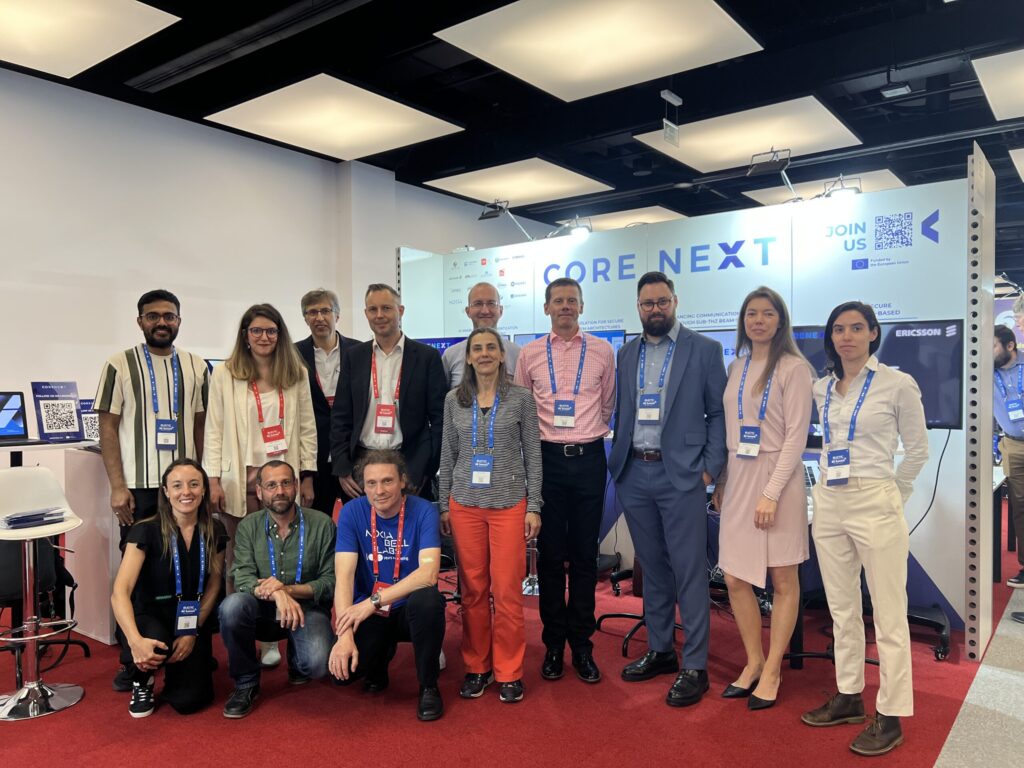
The COREnext project took centre stage at the EuCNC & 6G Summit 2025 in Poznań, Poland showcasing a forward-looking approach to connectivity and digital infrastructure. Located at Booth No. 53, the COREnext team engaged with visitors through six demonstrations and a series of in-depth discussions, offering insights into the project’s role in creating the next generation of secure network systems.
The COREnext booth attracted significant interest throughout the event, with guided tours introducing attendees to the project's live demonstrations. These highlighted how COREnext addresses critical challenges across architecture design, system integration, data protection, and trust management - key pillars for establishing a robust digital infrastructure.
6 live demonstrations
Each demonstration focused on a specific technological innovation or application area:
- Eavesdropper Avoidance
A sub-THz demonstrator featuring real-time beam steering. It illustrated how directional transmission significantly reduces the risk of data interception, enhancing communication security in high-frequency environments.
- High Datarate Interconnects over Plastic Fibre
This demo highlighted a high-speed link using polymer microwave fibres (PMF) in the H-band, demonstrating how these materials and methods can support future high-frequency, high-bandwidth communication systems.
- Radio Identification
Demonstrating the use of AI to distinguish individual radio devices based on transmitter-level imperfections. Even with identical chipsets, the system can reliably identify valid versus unauthorised transmitters, reinforcing trust at the physical layer.
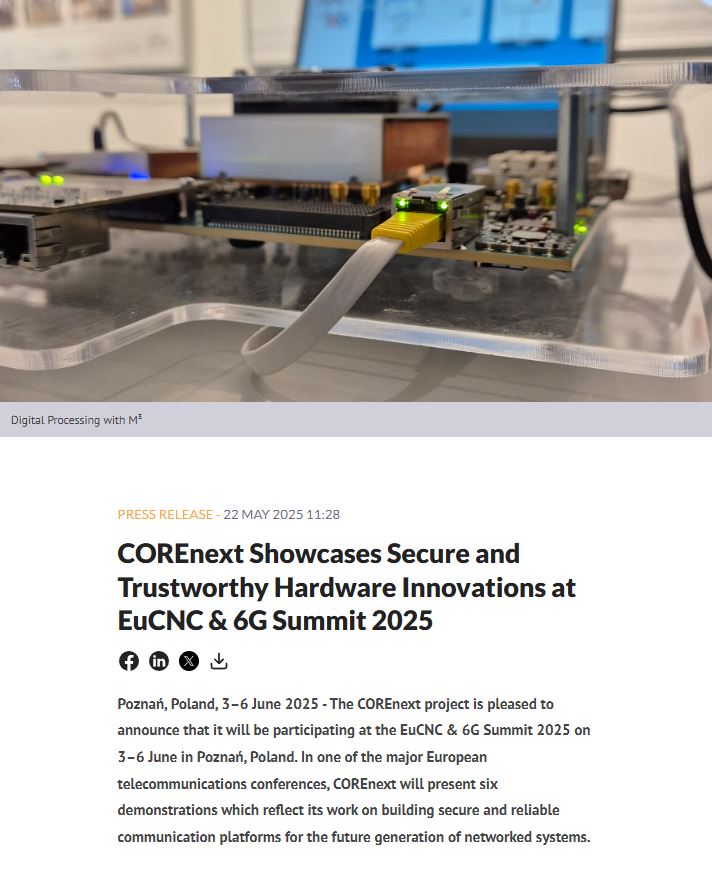
- Digital Processing with M³
This demonstration presented the M³ platform’s approach to secure, hardware-isolated processing. It showed how digital systems can be protected from internal and external threats through architectural separation and isolation.
- Secure Acceleration
We showcased secure hardware acceleration on an FPGA platform. The demo showed how privacy-preserving cryptographic processing can support sensitive data use cases, such as those in healthcare, while enabling multi-tenant deployment.
- Trust Evaluation and IoT Management
This demo introduced a Trust Manager that assesses IoT devices in real time. By assigning tasks based on trust levels and system resource availability, it ensures that devices operate reliably and securely across decentralised environments.
Engaging with experts
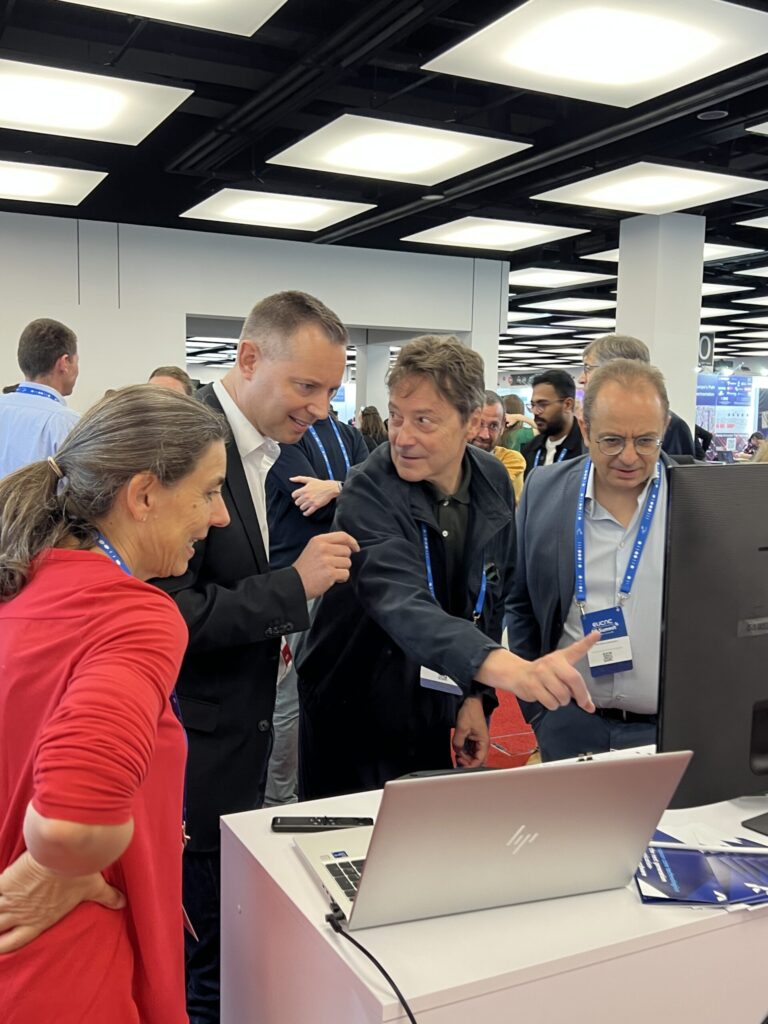
In addition to the demonstrations, the booth provided visitors the chance to speak with key contributors from across the COREnext consortium. Representatives from imec, AUSTRALO, Barkhausen Institut, Nokia, Infineon Technologies, Ericsson, Nokia Bell Labs, and WINGS ICT Solutions were present to offer technical insights and discuss the project’s strategic goals.
Apart from presenting these project results, the COREnext partners also discussed with academic researchers, industry representatives, and policy makers about shared goal of trustworthiness. EuCNC is a wonderful opportunity for projects to meet a diverse audience, to tune in with current challenges faced by industry, and to discuss forward-looking ideas with other researchers. The EuCNC experience will encourage COREnext to continue creating impact with innovative trustworthiness solutions and share results.
Looking ahead
The engagement with the research community, industry stakeholders, and policymakers reinforced the relevance of COREnext’s work in contributing to secure communication networks. The team extends its sincere thanks to all who visited the booth, participated in discussions, and provided feedback. Such interactions are valuable to assess the project’s direction as it progresses towards its final goals.
Watch the interview with Michael Roitzsch - COREnext Project Coordinator - during the EuCNC & 6G Summit Conference 2025:
Securing Efficiency with COREnext M³ Platform
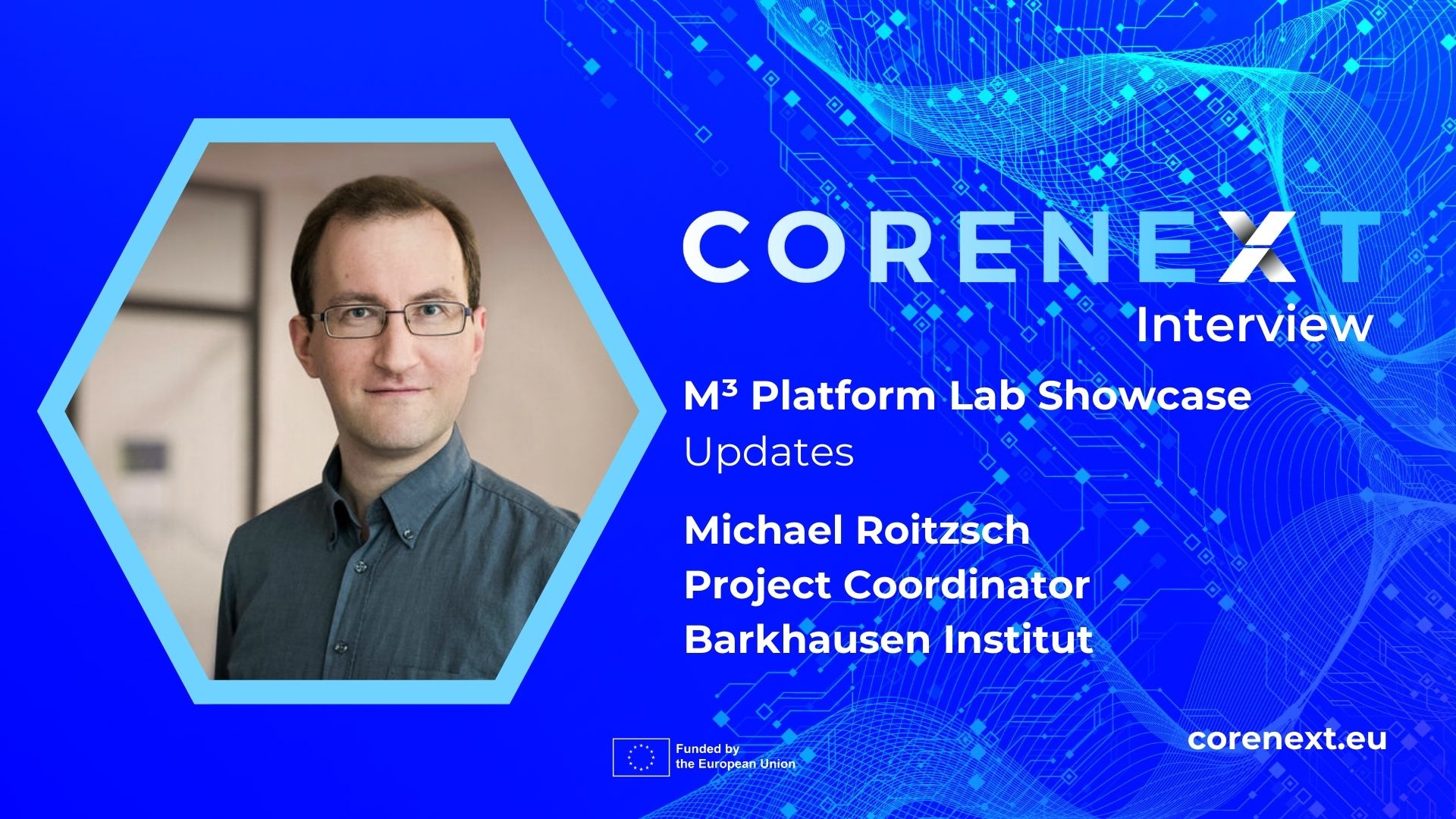
In an effort to move next-generation computing systems forward, Task 6.2 deals with the M³ (Modular, Multicore, and Managed) Platform, designed to enable secure and efficient system-on-chip (SoC) designs. In a recent interview, Michael Roitzsch, project coordinator at Barkhausen Institute, shared the recent progress and insights from the lab demo.
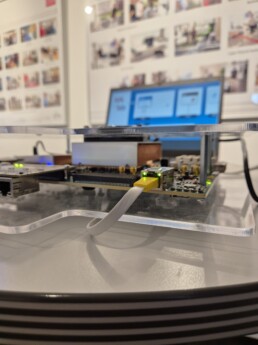
The M³ platform is a tile-based SoC design where each tile, whether a processor, an accelerator, or a memory controller, is protected by a Trusted Communication Unit (TCU). This allows each tile to execute independently and efficiently while the TCU addresses system-level security and isolation. According to Michael, this has been effective in integrating untrusted third-party IP blocks without compromising system integrity. "The TCUs do the isolation, so the tiles can do whatever they want. The isolation portion is separated from what's on the tiles," he said.
Measured Performance with Minimal Trade-offs
Prototypes of the M³ platform have been evaluated on FPGA and custom chip implementations. The results have shown minimal impact on most workloads on performance. "There is a bit of latency introduced by communication checks, but it doesn't play a large role in energy efficiency or throughput," Roitzsch noted. The approach offers robust security without compromising the high performance of the components.
Handling Cache Coherency and Future Enhancements
A key challenge to creating M³ has been figuring out how to implement security without sacrificing computational efficiency. By extending the burden of isolation out to the TCUs, the platform isn't forced to introduce a security obligation directly into each of the processing units. Roitzsch said an area that requires further development is cache coherency, which isn't presently supported. "It's a feature that's useful for certain workloads, and we'd like to do it in a trustworthiness-aware fashion—so even cache traffic is controlled by the TCU," he said.
As COREnext continues its progress, the M³ platform is still set to demonstrate the potential of secure, modular, and scalable SoC design—a foundation for disaggregated and composable computing systems of the future in Europe and beyond.
Join COREnext at EuCNC & 6G Summit 2025 in Poznań
COREnext will be present at the EuCNC & 6G Summit 2025, held from 3–6 June in Poznań, Poland, to showcase key outcomes of its work towards secure and trustworthy communication platforms for the next generation of networks.

The EuCNC & 6G Summit is one of the most established events for telecommunications in Europe, co-sponsored by the European Commission and IEEE Communications Society, bringing together leading researchers, industry experts, and policymakers to explore advances in 5G evolution and 6G development. More details about the event can be found on the official website: https://www.eucnc.eu/
VISIT US AT BOOTH NO.53
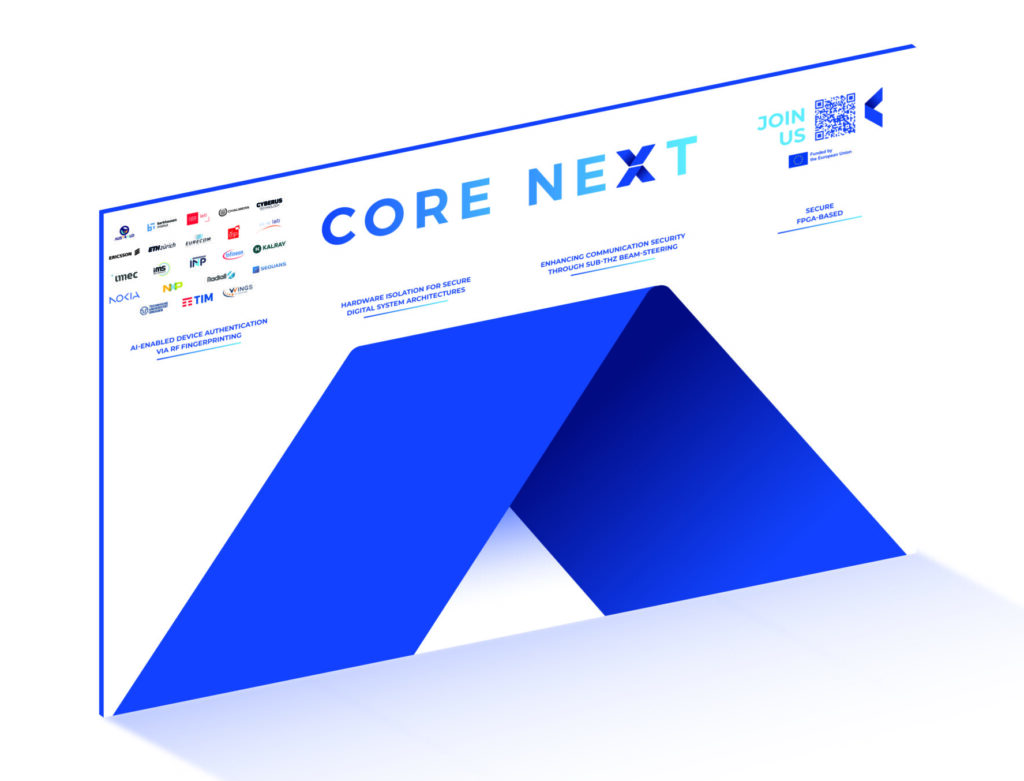
At the COREnext booth, 6 research demonstrations will be presented:
-
Eavesdropper Avoidance
This sub-THz demonstrator shows beam-steering capabilities as a feature to enhance link security. It consists of baseband signal processing and radio transceivers for analogue beam-steering with four front-ends and antennas. A pedagogic interface enables the viewer to visually control and interact with the radio hardware. -
Radio Identification
The Radio Fingerprint demonstrator illustrates how real hardware can be identified by advanced AI. Non-idealities at component level in the transmitter make each radio unique and create opportunities for efficient identification by employing ML models. The audience will experience how the ML can recognize authorized radios, as well as identify unauthorized ones despite using similar chipsets. -
Digital Processing
With M³ we demonstrate a platform for isolating hardware building blocks within a heterogeneous system. The isolation protects the overall system from hardware flaws that could otherwise enable malicious software to compromise the system. -
Secure Acceleration
Digital platforms require hardware acceleration to operate efficiently. The demo shows an FPGA acceleration board that can be securely shared by multiple tenants. A key exchange protocol and cryptographic components enable data processing with sensitive information like health data. - High datarate interconnects over plastic fiber
This demo is based on the concept of high speed data link for communication via PMF in the H-Band, and PMF coupler in package at H-Band.
- TrustEvaluation and IoT Management demo
The demo showcases how the Trust Manager evaluates IoT devices in real time using trust metrics, updating each device’s trust index dynamically. Based on these values and resource availability, the Trust Manager Orchestrator assigns tasks to the most reliable and capable devices, ensuring secure and efficient operation.
DOWNLOAD THE CONFERENCE COREnext TRIFOLD
Each demo is interactive and explained by COREnext experts on site. Attendees will gain insights into how hardware-level innovations can address growing challenges in secure and resilient digital infrastructure.
Want to know more stories from COREnext? Subscribe to our newsletter and follow us on LinkedIn, X, BlueSky, and YouTube to keep up to date!
COREnext Task 6.4: Tackling the Future of High-Speed Data Transmission
In a recent interview, Franz Dielacher shared key insights on the progress of Task 6.4 in the COREnext project, which focuses on addressing the growing demand for high-speed, energy-efficient data transmission, particularly for telecom systems and data centres.
As the volume of data continues to grow, traditional electrical interconnects are reaching their limits due to signal degradation at higher frequencies and the costly processing needed to maintain signal quality. While optical technologies excel over long distances, they remain complex and expensive for short-range use.
To address this challenge, COREnext is exploring polymer waveguides (plastic optical fibres) as a viable solution for short-range communication (up to a few metres). These fibres offer a strong balance of performance, cost-effectiveness, and ease of integration. The project has already demonstrated over 100 Gbit/s in the D-band (130–170 GHz) and achieved 30 Gbit/s in early H-band (200+ GHz) trials, even using cables not yet optimised for that frequency range. With dedicated materials, the team expects to surpass 100 Gbit/s in the H-band as well.
Franz also highlighted progress in antenna integration, including on-chip, on-board, and antenna-in-package coupling methods—crucial for efficient signal transfer. Key performance indicators such as data rate, energy efficiency (pJ/bit/m), cost per Gbit, and robustness show strong results for polymer fibre technology. Looking ahead, COREnext is planning further dissemination in 2025, including workshops at European Microwave Week and collaboration with academic partners such as KU Leuven.
Want to know more stories from COREnext? Subscribe to our newsletter and follow us on LinkedIn, X, BlueSky, and YouTube to keep up to date!

COREnext 3rd Plenary Meeting: Progress, Demonstrations, and Future Plans
The 3rd COREnext Plenary Meeting took place in Frankfurt/Oder on 13-14 February 2025, bringing together partners, researchers, and industry stakeholders to review progress, discuss key advancements, and align on the final steps towards project completion. Over two days, participants engaged in valuable discussions, assessed achievements against project KPIs, and explored technological demonstrations.
The meeting began with a warm welcome from Michael Roitzsch (Barkhausen Institut), the Project Coordinator, followed by a Mid-term Review summary presented by Fredrik Tillman (Ericsson). The agenda focused on tracking the project’s progress and defining strategies to meet the final-year objectives.
A significant portion of the meeting focused on Work Package updates, covering key advancements across various areas. Discussions addressed Digital & Trustworthy Analogue Components, highlighting efforts to enhance reliability and security in emerging computing architectures. The Lab Validators update provided insights into real-world application testing and technology readiness, and the Computation-Communication Platform session examined progress in integrating computing and communication technologies. Finally, the Outreach, Exploitation & Collaboration segment explored strategies to maximise project impact and strengthen industry partnerships.

Technological Demonstrations
The meeting featured key technological demonstrations showcasing advancements in security, efficiency, and system integration. Ericsson AB presented the Hardware Fingerprint Concept, a security mechanism that utilises the unique imperfections of radio hardware for secure communication and location authentication. Nokia demonstrated FPGA Multi-Tenancy, highlighting innovations in resource-sharing and scalability within FPGA-based architectures. Additionally, Barkhausen Institut showcased the M³ Platform, emphasising hardware/software co-design that enables seamless integration of heterogeneous accelerators into a unified system-on-chip, enhancing communication and computational efficiency, while IMEC demonstrated their work on using beam direction to prevent eavesdroppers from receiving a useful signal.

The Final Year of COREnext
As the project enters its final year, the focus remains on delivering impactful results. The meeting provided a valuable opportunity to reflect on progress, strengthen collaboration, and plan for the final phases of technology validation and dissemination.
A huge thank you to all participants for their engagement and contributions, and to IHP for hosting and organising this event. The insights and discussions from this meeting will ensure COREnext is going to achieve its objectives and leaves a lasting impact on the future of computing and networking.
Want to know more stories from COREnext? Subscribe to our newsletter and follow us on LinkedIn, X, BlueSky, and YouTube to keep up to date!

COREnext's Progress, Technological Achievements, and Impact on Sustainability
The COREnext project is at a crucial milestone as it undergoes its Mid-term Review, bringing together project partners and reviewers to assess progress, achievements, and challenges. This review is essential for reflecting on the project's ambition, its technological advancements, and the impact made in the first period. We are excited to talk with the COREnext Project Coordinator, Michael Roitzsch to gain insights into the review, discussing key highlights and lessons learned, and what lies ahead for the remainder of the project.

During the Mid-term Review, there was a focus on the project's ambition. How would you describe the progress made during the first period, and did it meet your expectations?
MR: The overall goal of COREnext is to infuse the next generation of mobile communication networks with trustworthiness built-in by default. In the beginning of the project, we had to stake out what this actually means and how we could design an architecture to support this vision. From this architecture, concrete component needs were derived. In the first period, the COREnext project not only delivered all of this work but can already show the first prototypes on the required components. We now have the building blocks we can put together in the second period.
In the technology achievements section, WP2 Trustworthiness and use cases were presented. What key developments have been made in ensuring trustworthiness across the project's use cases, and why are they important for COREnext's success?
MR: We selected three model use cases as condensation points for our thinking about trustworthiness. These are: augmented reality and XR, automotive infrastructure, and a smart city platform. Each of these use cases has clear requirements, where they are different from others: XR needs very low latency communication and high throughput data transfer. Automotive applications must securely coordinate between multiple participants and roadside infrastructure all acting within a distributed system. Finally, smart city use case emphasizes sustainability and energy efficiency needs. But across all these, trustworthiness is a common concern.
With WP3 focusing on disaggregation and computing architecture, how is the project advancing in terms of its goal to create a robust computing architecture for the next-generation infrastructure?
MR: In WP3, the project architecture must balance contradicting needs. Just some examples: Disaggregation increases flexibility by allowing flexible assignment of compute jobs to resources but can worsen energy consumption and overall efficiency. Improving security and isolation of processing workloads benefits trustworthiness but can worsen communication latency. We must think about these trade-offs and find solutions that balance or work around these constraints.
What are the key milestones achieved so far in the development of digital components, and how do they align with the project’s overall objectives (WP4)?
MR: WP4 addresses key elements of the mobile communication signal processing chain, replacing or advancing existing components to improve energy efficiency and trustworthiness. We have the first prototypes based on RISC-V processors as well as the M3 architecture for isolated computation. These components will be developed further and evaluated in the second period.
What specific roles do the analog components play in the broader context of the project’s architecture, especially in terms of signal processing and energy management (WP5)?
MR: The wireless radio interface is the most exposed and therefore most attackable interface. We have to particularly harden it against spoofing and malicious communication. In addition, we are developing polymer fibers as a novel interconnect technology for energy efficient disaggregation. These components complement the COREnext architecture.
What are the primary goals of the computation-communication platform integration, and what progress has been made toward achieving them (WP7)?
MR: Within WP7, COREnext will follow in the footsteps of the COREnect project and consult with industry and other external experts to compose a roadmap for further research needed. Within the first period, we conducted initial discussions internally but will bring these thoughts to a wider audience in the second period.
What have been the key findings from the lab validation tests conducted so far, and how do they impact the project's development trajectory (WP6)?
MR: Lab validation is still mostly in the planning phase and will ramp up significantly in the second period. We will verify that the components we have developed actually meet the expectations required by the COREnext architecture. This work package will be the ultimate reality check for our research.
The review agenda highlights a discussion on the project’s impact. What have been the major challenges or successes in demonstrating the technical output from period 1, and how has it influenced the next steps for COREnext?
MR: COREnext has made great progress in the first period. We have summarized our viewpoints, our vision, and our agenda in a whitepaper. It is available on the project website and presents our mission of bringing trustworthiness to the future of our communication infrastructure.
The COREnext project aims to contribute to several Sustainable Development Goals (SDGs). How do you see the project's technological advancements aligning with these SDGs, and what impact do you anticipate in terms of sustainability and societal benefits?
MR: We believe that trustworthiness in something as essential as our communication networks is a major foundation for our democratic society. In this sense, we contribute to the goals of stability and privacy. But COREnext also contributes to improving energy efficiency, which helps to realize a sustainable energy future.
How has the project management strategy ensured smooth coordination among the different work packages, and what are the key challenges in managing such a multidisciplinary team across various technical areas (WP1)?
MR: Our approach has been to foster collaboration amongst the partners with a flexible meeting structure. Ultimately, it is the individual researchers who make the tangible contributions, so it is also important to give them enough time and space to do their best work. Regularly we meet in person or online to update each other and coordinate the way forward.
Want to know more stories from COREnext? Subscribe to our newsletter and follow us on LinkedIn, X, and YouTube to keep up to date!

COREnext Trustworthy Analogue Components
Work Package 5 (WP5) of the COREnext project focuses on improving the reliability and performance of communication links through the development of analogue components. By leveraging hardware imperfections and advancing ultra-high-speed interconnect technologies, WP5 aims to provide secure and energy-efficient solutions for next-generation communication systems.
 Enhancing Radio Link Trustworthiness
A significant focus of WP5 is the development of Radio Frequency Fingerprinting (RFF) technology. This method uses inherent hardware imperfections to enhance the reliability and security of radio links. Necessary training to validate RFF concepts data are obtained from software and hardware platforms covering different frequency bands, namely a sub-6GHz software-defined-radio, a sub-10GHz transmitter testbench and a sub-THz multiuser MIMO simulation platform. The latter one is furthermore designed to evaluate link robustness to imperfections and security threats such as eavesdropping in the challenging D-band.
Advancing Ultra-High-Speed Interconnects
WP5 is making progress in developing short-range, high-speed data communication using Plastic Microwave Fibres (PMFs). These fibres offer a practical alternative to traditional interconnects due to their low cost, reduced energy consumption, and adaptability to high-frequency ranges such as the H-, Y-, and D-bands. Recent achievements include the design and prototyping of integrated transmitters and receivers using advanced BiCMOS processes. Measurements have shown data transmission rates of up to 102 Gbps in the D-band and 30 Gbps in the Y-band. Additional work has focused on developing packaging solutions, including 3D-printed PMF holders and low-k material designs, to enhance integration and efficiency.
Sustainability and Industry Impact
WP5 also aligns with sustainability objectives by proposing means to reduce energy consumption and adopting environmentally friendly materials. For instance, the use of PFAs-free materials in PMFs addresses environmental and health concerns associated with traditional materials. Furthermore, a patent application has been submitted for the RF Fingerprinting authentication method, which highlights its potential to contribute to industry standards and practices. The work undertaken in WP5 supports an increase in technology readiness levels (TRLs) and creates opportunities for applications in secure and efficient communication hardware.
WP5’s developments in analogue components contribute to improving the trustworthiness and performance of communication systems. By addressing both security and operational efficiency, the results of this work support the foundation for reliable and energy-conscious networks in the 6G era.
Want to know more stories from COREnext? Subscribe to our newsletter and follow us on LinkedIn, X, and YouTube to keep up to date!

COREnext’s progress in Digital Components for 6G
The COREnext project’s Work Package 4 (WP4) focuses on developing foundational digital components for communication systems. By addressing key areas such as hardware acceleration for power efficient signal processing and protocol acceleration, hardware orchestration and trusted environments, WP4 contributes to the advancement of technologies required for 6G networks. Recent progress demonstrates developments in these areas.

Efficiency Increase
WP4 has delivered solutions aimed at improving the energy efficiency of communication systems. The introduction of programmable many-core RISC-V accelerators, including the TeraPool-SDR cluster, supports low-latency and high-throughput tasks necessary for 5G and future 6G systems. Additional work on vector processing accelerators and LDPC decoders has enabled efficient and reliable data transmission with throughput capabilities reaching gigabit-per-second levels. To optimise resource usage, WP4 developed AI-based MAC scheduling accelerators that improve resource allocation in complex networks.
Security Enhancements
In terms of security, the TokSek framework enables multi-tenant use of FPGA resources in cloud environments while maintaining data integrity and confidentiality. This approach addresses challenges in securely sharing hardware resources.
Further advancements include the virtualisation of DSPs to improve computational resource management and the development of tile-based processing platforms equipped with isolation mechanisms to enhance security. RF fingerprinting, used for device authentication, provides an additional layer of trust by accurately identifying devices in communication networks.
Contributions to Research and Standardisation
WP4 has produced several publications documenting the outcomes of its work, with contributions to open-source tools and methods. The RF fingerprinting technology has led to a patent application, indicating potential for future applications in communication systems.
The work aligns with Sustainable Development Goals (SDGs), particularly SDG9 (Innovation in Infrastructure) and SDG11 (Sustainable Cities). By focusing on energy efficiency, WP4 supports the broader goals of sustainable and resilient communication systems.
Readiness for Deployment
The technology readiness levels (TRLs) of platforms developed under WP4 have increased, indicating progress towards deployment. The validation of the RISC-V environment, encompassing both hardware and software, creates opportunities for practical application and further development in communication technologies.
WP4’s ongoing work in digital components contributes to the technical objectives of the COREnext project, with progress focused on addressing practical needs and ensuring alignment with long-term goals for communication system development.
Want to know more stories from COREnext? Subscribe to our newsletter and follow us on LinkedIn, X, and YouTube to keep up to date!

COREnext at Nokia Bell Labs Seminar: Driving Innovation with Impact
This summer, Nokia Bell Labs hosted an internal seminar that brought together around 40 participants, creating an engaging platform for knowledge sharing and collaboration. One of the highlights of the seminar was a presentation by José Luis González Jiménez from CEA-Leti, who delivered an insightful talk titled "Recent Investigations of Channel Aggregation Transceiver Architectures for D-band and H-band Communications".
The presentation showcased the latest research in advanced communications architectures, including contributions from the COREnext project.

Motivations for Polymer Microwave Fiber Communications
One part of the presentation focused on the motivations for Polymer Microwave Fiber (PMF) communications, where COREnext research was highlighted. PMF technology represents a new frontier in high-data rate communications, offering significant benefits for professional connectivity, data centers, connected industries, and medical equipment. The technology aims to replace traditional optical cables, such as 10-25GbE optical links, with more efficient solutions, providing telecom fronthaul applications with better flexibility and scalability.
The research also emphasized the role of PMF communications in bridging the gap between Baseband Units (BBUs) and Radio Heads (CPRI), showcasing how this approach could replace conventional optical cables, offering enhanced performance for on-board interconnections in various industrial and medical sectors.
Sustainability and Industry Impact
For nearly 100 years, Nokia Bell Labs scientists have made many groundbreaking discoveries and innovations including the transistor, the laser, Information Theory, UNIX and more. These breakthroughs have been recognized in the awarding of hundreds of prestigious prizes, including ten Nobel Prizes and five Turing Awards. Nokia Bell Labs continues to champion disruptive technologies for improving sustainability to make a measurable impact on society. By integrating the research results of projects like COREnext, Nokia Bell Labs is advancing the vision of connected industries that operate more efficiently, with reduced energy consumption and lower environmental impact.
Want to know more stories from COREnext? Subscribe to our newsletter and follow us on LinkedIn, X, and YouTube to keep up to date!