

CORENEXT
SOLUTIONS
COREnext Demonstrations
COREnext showcases a series of demonstrators that highlight how trustworthiness, security, and efficiency can be embedded in next-generation communication and computing systems. Each demonstration reflects a different layer of the 6G ecosystem – from radio hardware to secure computation.
Trust Evaluation and IoT Management
Working towards end-to-end trustworthiness for interconnected IoT systems.
Developed by: WINGS ICT Solutions

This demonstration presents a Trust Management Orchestrator that evaluates IoT devices in real time, calculating a trust index for each based on performance, reliability, and security metrics.
The orchestrator dynamically assigns tasks to the most trustworthy and capable devices, ensuring secure, efficient, and adaptive operations across distributed IoT environments.
Highlights:
- Real-time trust evaluation using multiple metrics (availability, security, reliability, energy).
- Automated orchestration of device workloads based on trust index.
- Visual graphs of trust scores and execution time.
RF Fingerprinting for Wireless Network Security
A step towards AI-driven, hardware-rooted wireless network security.
Developed by: Ericsson

The RF Fingerprint demo illustrates how AI and machine learning can recognise individual radio transmitters based on tiny hardware imperfections, strengthening physical-layer security.
By analysing unique signal patterns, the system authenticates authorised devices without cryptographic keys, offering a lightweight and robust approach to prevent spoofing or impersonation.
Highlights:
- Machine learning models trained on hardware-specific signal signatures.
- Real-time classification and device authentication.
- Enhanced physical-layer security complementing traditional cryptography.
Sub-THz Beam-Steering for Secure Links
Demonstrating secure, adaptive, and high-capacity communications at sub-THz frequencies.
Developed by: IMEC
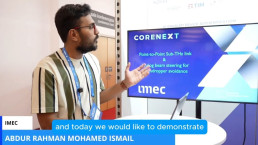
This interactive sub-THz demonstration shows how beam-steering technology enhances link security by preventing eavesdropping. The system dynamically controls signal direction, keeping communications private and efficient.
Highlights:
- Real-time beam control with four RF front-ends and antennas.
- MATLAB baseband processing for dynamic link management.
- Practical physical-layer cybersecurity for future high-frequency networks.
High Data-Rate Interconnects over Plastic Fiber
A breakthrough towards energy-efficient, ultra-fast data transfer systems.
Developed by: Infineon Technologies

This demonstrator presents the first in-package Polymer Microwave Fiber (PMF) coupler operating in the H-Band, providing a compact, low-loss, and energy-efficient solution for high-speed communication.
By integrating PMF technology into a package with MMICs in eWLB format, the solution supports data rates up to several tens of Gbit/s — ideal for next-generation data centres and high-performance computing.
Highlights:
- H-Band PMF coupler realised in-package.
- Low-loss interconnects with reduced energy use.
- Scalable for short to medium-distance high-speed links.
Secure Acceleration (FPGA)
Towards secure and efficient hardware acceleration in shared digital infrastructures.
Developed by: Nokia
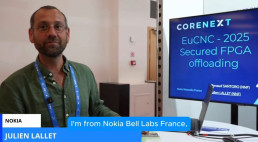
The Secure Acceleration demonstration highlights FPGA-based hardware acceleration for multi-tenant environments, enabling sensitive data processing with robust cryptographic protection.
Using layered encryption (AES and ECC), the setup ensures data confidentiality even when multiple users share FPGA resources — a key step for secure and efficient cloud and edge computing.
Highlights:
- AES + ECC encryption for secure FPGA offloading.
- Secure multi-tenant hardware resource sharing.
- Real-time, privacy-preserving data processing for healthcare and beyond.
Trustworthy Computer Platform – M³
Building secure and reliable architectures for future digital platforms.
Developed by: Barkhausen Institut
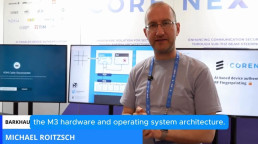
The M³ platform demonstrates a modular and secure computing architecture that isolates hardware components into independent, trusted execution zones.
This hardware-level isolation limits the impact of faults or attacks, providing resilience and containment in heterogeneous computing environments.
Highlights:
- H-Band PMF coupler realised in-package.
- Low-loss interconnects with reduced energy use.
- Scalable for short to medium-distance high-speed links.
USE CASES
COREnext technologies drive innovation across smart cities, automotive systems, and extended reality (XR) by combining high-speed communication, trusted computing, and secure data processing. They enable reliable, low-latency, and energy-efficient digital infrastructures that support connected vehicles, intelligent city services, and immersive applications, advancing a secure and human-centric digital future.


EXTENDED REALITY
Use Case
Enhanced Human Communication and Entertainment
Enhanced Human Communication and Entertainment represents the family of use-cases involving human devices enabling users to interact with digital content in a more immersive and natural way. Human interaction involves specific requirements deriving from the involvement of human senses (part of the success of the interaction depends on the capability of reality reproduction). The use case to be investigated within this family is the Extended reality (XR) use case.


AUTOMOTIVE INFRASTRUCTURE
Use Case
Enhanced Machine Communication
Enhanced Machine Communication represents the family of use-case involving non-human communication or interaction. This interaction can benefit of information compression, non-human communication is often required for safety when the ability to react of non-human actuator is higher than a human reaction. The use case to be investigated within this family is the Automotive infrastructure use case.


SMART CITY
Use Case
Intelligent Management
Intelligent Management represents a family of use-case involving decision based on the collection of Information provided by multiple network elements (RAN nodes, edge nodes, sensor nodes). The main requirement for this family is the capability to collect high amount of data and a high level of data processing performance for algorithm training (ensuring the data security and trustworthiness). The use case to be investigated within this family is the Smart city use case.